How to Make Clients Actually Read Your Marketing Reports
TLDR: To make clients read your marketing reports, focus on clear insights instead of raw data, keep reports concise, add an executive summary, connect metrics to business impact, and highlight next steps. When reports are simple, visual, and goal-oriented, clients are far more likely to engage with them.
You put time into your marketing reports.
You double-check your data sources. You analyze campaign performance across SEO, social media, paid ads, and email. You try to clearly demonstrate the impact of your marketing efforts.
And still… sometimes it feels like your client barely looks at it.
If you’ve ever wondered how to make clients read marketing reports, or even how to improve client reporting overall, you’re not alone. This is a common frustration for any digital marketing agency, consultant, or in-house marketing team.
The good news? It’s rarely about effort. It’s about clarity, structure, and client communication.
Let’s break down how to present marketing reports to clients in a way that strengthens client relationships, improves client retention, and turns your reports into strategic tools.
- 1. Focus on Actionable Insights, Not Just Metrics
- 2. Keep It Clear and Concise
- 3. Start With Key Takeaways in an Executive Summary
- 4. Make It Visual and Easy to Navigate
- 5. Personalize Your Agency Reporting Experience
- 6. Walk Through the Report Together
- Make Reporting Easier With DashThis
1. Focus on Actionable Insights, Not Just Metrics
Most agency clients don’t ignore reports because they don’t care.
They ignore them because they don’t immediately understand what they’re looking at.
As marketers, we spend a lot of time learning and working with different key performance indicators. But if you put yourself in the shoes of someone who doesn’t live and breathe marketing metrics every day, it’s easy to see how overwhelming they can feel.
Impressions, CTR, conversion rate, SEO rankings, ad spend, social media reach, WHEW.
So instead of listing numbers from your latest marketing campaign without context, guide your client through the story behind the data:
-
What changed?
-
Why did it change?
-
What does it mean for the client’s business?
Every effective client reporting process should clearly answer three questions:
-
What happened?
-
Why did it happen?
-
What are we doing next?
That final question is crucial.
Insights shouldn’t only explain campaign performance, it should explain your next moves.
Side note, this is where AI insights and automation can support your reporting process. AI can surface real-time trends across multiple data sources, detect anomalies, and highlight shifts in campaign performance. But it’s your job to turn those insights into clear, high-quality strategic recommendations.
When your marketing reports combine only the most crucial data, interpretation, and forward-looking action, they stop being static summaries. They become roadmaps aligned with business objectives.
2. Keep It Clear and Concise
One of the biggest mistakes in agency reporting is trying to prove value by showing everything.
Marketing teams often pull data from dozens of different channels: Google Analytics, ad platforms, SEO tools, social media dashboards, and feel tempted to include it all. The result? A marketing dashboard that’s too long and that hides what truly matters.
Instead, focus on the marketing KPIs that directly support the client’s business objectives.
If a metric doesn’t connect to your client’s goals or serve as a useful benchmark for performance, consider removing it.
The easier your marketing reports are to scan, the more likely your agency clients are to read them.
3. Start With Key Takeaways in an Executive Summary
If your client reads only one section of your report, make it the executive summary.
This is where you present the key takeaways from your marketing efforts.
In just a few short paragraphs, summarize:
-
Overall campaign performance
-
Major wins or losses
-
Important shifts in SEO or social media results
-
What you’re optimizing next
This helps decision-makers and other stakeholders quickly understand how the marketing campaign performed and what’s coming next. An executive summary also improves client communication. It shows that you’re not just reporting data, you’re managing strategy.
4. Make It Visual and Easy to Navigate
Spreadsheets and raw exports can quickly discourage engagement.
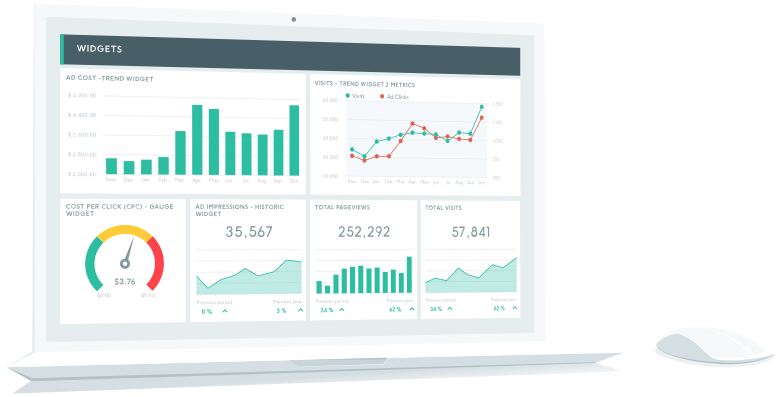
Instead, use a visually appealing marketing dashboard that relies on strong data visualization.
-
Graphs, comparisons, trend lines, and clearly labeled key metrics help clients understand performance at a glance.
-
Bullet points can highlight key takeaways. Visual benchmarks can show progress month over month.
-
Organized sections can separate SEO performance, social media performance, and paid campaigns.
Using a report automation tool like DashThis helps marketers streamline data collection, reduce reporting errors, and free up time to focus on strategy.
5. Personalize Your Agency Reporting Experience
Generic reports feel transactional, but personalized reports can strengthen client relationships.
Add the client’s logo. Use their brand colors. Customize your marketing dashboard to reflect what matters most to their business.
For example, an eCommerce client may prioritize ROAS and conversion rate benchmarks. A B2B client may focus more on pipeline value and cost per qualified lead.
Tailoring your client reporting shows that you understand their client’s business strategy, not just their data.
For marketing agencies managing multiple agency clients, or looking for new clients, personalization is a powerful differentiator.
6. Walk Through the Report Together
Even the most well-designed client reporting dashboard can feel intimidating to non-marketers.
Take time to walk your clients through the structure of your marketing reports. Show them where to focus, how to interpret campaign performance, and how your reporting process connects to their larger marketing strategy.
Once clients understand how to read your reports, they’re far more likely to engage with them independently.
Make Reporting Easier With DashThis
At the end of the day, getting clients to read your marketing reports isn’t about adding more data, it’s about making that data meaningful.
When your reports are clear, focused on actionable insights, visually structured, and aligned with your client’s business objectives, they naturally become easier to engage with. Add a strong executive summary, explain your next moves, and use automation to simplify the reporting process, and your reports shift from routine updates to strategic conversations.
If you want to save time while improving client engagement, DashThis can help.
With ready-to-use marketing report templates and powerful report automation, you can pull data from all your channels into one clean, visual dashboard in minutes.
-
Less time building reports.
-
More time delivering strategy.
-
And better-looking dashboards your clients will actually open.
Because when reporting is simple, visual, and automated, everyone wins.

Create Reports Your Clients Actually Want to Open
Read More

Don’t miss out!
Follow us on social media to stay tuned!


Automate your reports!
Bring all your marketing data into one automated report.
Try dashthis for free