KPI

What Are LinkedIn Impressions? Definition, Benchmarks & How to Track Them

So what are impressions on LinkedIn exactly? They represent the total number of times any LinkedIn post, update, or ad is displayed, whether or not someone clicked on it. In this post, we will outline what they are, how to measure them, and how to improve your metrics when you want more impressions on this professional network.

TRACK YOUR LINKEDIN IMPRESSIONS!

  • 4 +

    TEMPLATES USING THIS KPI

  • 1

    INTEGRATION USING THIS KPI

What are Linkedin impressions?

This metric in LinkedIn analytics will tell you the total times your post was seen, not reflective of a unique number of views. Impressions are a great window into your overall LinkedIn marketing benchmarks and indicate your growing brand awareness. However, since it is just the total number of times your post was seen, this metric will not provide granular data about your target audience, click-through rate (ctr), or the success of your type of content and content strategy.
Track your LinkedIn impressions today

What are the different types of impressions on LinkedIn?

LinkedIn actually tracks three distinct types of impressions, and knowing the difference helps you interpret your analytics more accurately.

Organic impressions

Organic impressions are the views your content earns naturally — no ad spend required. When you publish a post and it appears in someone's feed because they follow you or one of their connections engaged with it, that counts as an organic impression. This is the baseline metric most marketers focus on when evaluating their content strategy.

Paid impressions

Paid impressions are generated through LinkedIn's advertising products — Sponsored Content, Message Ads, Dynamic Ads, and so on. If you're running a LinkedIn campaign, paid impressions count every time your ad is served to someone's screen. These are tracked separately in LinkedIn Campaign Manager and don't mix with your organic data in LinkedIn Page Analytics.


Viral impressions

Viral impressions are the most misunderstood of the three. A viral impression is counted when someone who doesn't follow your page sees your content because a connection of theirs liked, commented on, or shared it. In other words, your post "travelled" beyond your direct audience. LinkedIn surfaces this metric in Page Analytics and it's one of the clearest signals that a piece of content is resonating with them. 


How to calculate LinkedIn impressions?

Because impressions are a standard metric listed in LinkedIn analytics, no formula is needed to calculate the value. Instead, you can check the analytics tool to see the impression count reflected for your use, providing valuable insights into the reach and visibility of your content.

What are good LinkedIn impressions?

Good LinkedIn impressions are relative to your follower count, but there are practical benchmarks you can use to gauge where you stand. As a general rule of thumb, a healthy post should reach roughly 10–30% of your total follower count in organic impressions. So if your LinkedIn Page has 2,000 followers, 200–600 impressions per post is a reasonable baseline to target. If you're consistently hitting above 30%, your content is performing well and likely benefiting from viral distribution.

Track yours with an automated report

What are bad LinkedIn impressions?

There's no hard floor for a "bad" number, but there are warning signs worth paying attention to. If your posts are consistently reaching fewer than 5% of your follower count, that's a signal the algorithm is deprioritizing your content, usually because recent posts haven't generated much early engagement. For example, a page with 10,000 followers seeing only 200–300 impressions per post is underperforming significantly. 

Track yours with an automated report

LinkedIn impressions KPI examples & templates

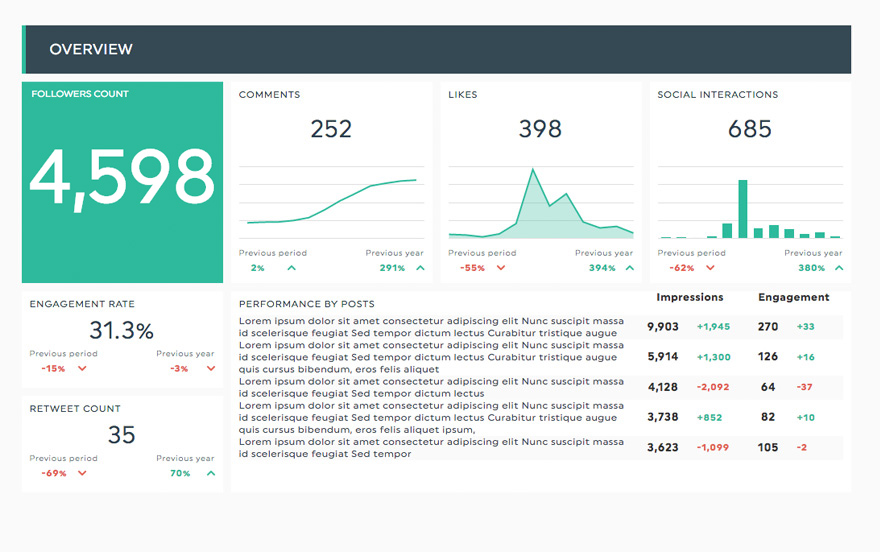
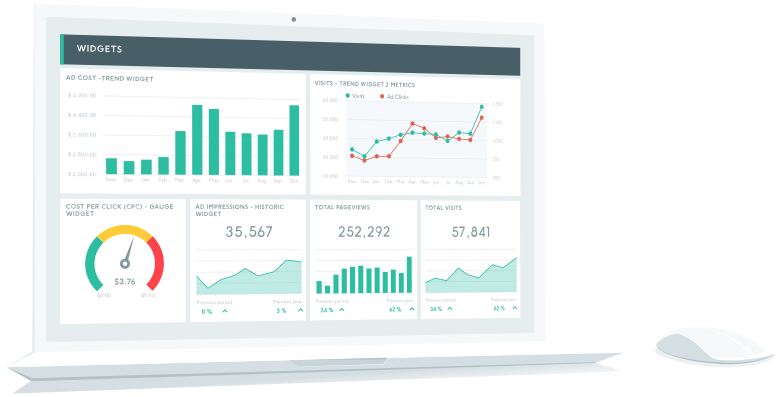
Your LinkedIn impressions can be added to multiple different types of reports. Here are some of them:

See this KPI in action here!

LinkedIn report template LinkedIn report template

Our LinkedIn report template has everything you need to track your LinkedIn marketing campaigns and we've made it super easy for your marketing team to get started. 

See this template live

Social media report template Social media report template

Our social media report template has everything you need to get your marketing team started quickly: it’s pre-built with the standard social media metrics and KPIs you need and fully customizable so that you can visualize the data you want the way you want. 

See this template live

community management report template Community management template
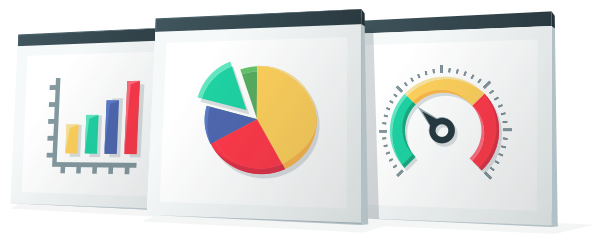
Track all your social media performance, and show your social media strategy results to your boss in no time! Spend less time reporting and more time on growing your community with this all-in-one community management report template.

See this template live

Get 10 free dashboards for 15 days

TRY DASHTHIS TODAY

LinkedIn Impressions best practices

If you are seeing low figures in your engagement rate and underperformance on the LinkedIn newsfeed, it may indicate that your impressions mean you need a higher number of people with access to your content. Here are some tips to boost your performance on the social network and enhance your LinkedIn presence, including optimizing your posting schedule.

Pageviews best practices

step 1 icon Optimize Your Profile

Ensure your LinkedIn profile is complete, professional, and engaging to attract organic impressions from LinkedIn users and expand your reach to a wider audience. Use a high-quality profile picture to make a strong first impression, craft a compelling headline that grabs the attention of other LinkedIn users, use hashtags, and write a captivating summary highlighting your skills and experiences. Incorporate relevant keywords strategically throughout your profile to increase visibility in search results and make it easier for users to find you on LinkedIn.

step 2 icon Create Engaging Content

Regularly share valuable content such as articles, posts, videos, and updates that resonate with your target audience. Provide insights, share industry news, offer tips and advice, and participate in relevant conversations tailored to your demographics and industry niche. Visual content, including images, videos, and infographics, tends to perform well on LinkedIn, enhancing your content reach and getting many clicks on your posts. Additionally, incorporating case studies and high-quality content and increasing the posting frequency can elevate LinkedIn engagement with a broader audience.

step 3 icon Engage with Your Network

Actively engage with your connections by liking, commenting, and sharing their LinkedIn content. This helps to strengthen your professional relationships and boosts your post impressions by signaling relevance to the LinkedIn algorithm. By interacting with your network, you increase the likelihood of your piece of content being featured in their LinkedIn feeds, organically, and through paid impressions. Participating in LinkedIn Groups and contributing to discussions can further expand your reach and visibility within your industry or niche.

step 4 icon Post at the Right Time for Your Audience

Timing has a meaningful impact on how many people see your content when it first goes live, and that early window matters. LinkedIn's algorithm gives extra distribution weight to posts that rack up engagement quickly, so publishing when your audience is actually scrolling increases the chances of that initial burst. For most B2B audiences, Tuesday through Thursday between 8–10am and 12–1pm in the audience's primary timezone tend to outperform other windows, but your LinkedIn Page Analytics will show you exactly when your followers are most active. Check the "Followers" tab and post accordingly rather than guessing.

step 5 icon Use Native Document and Carousel Posts

LinkedIn's algorithm consistently favors content that keeps people on the platform longer, and native document posts (PDF carousels) are one of the highest-impression formats available right now. Unlike link posts — which LinkedIn actively suppresses in reach because they send users offsite — document posts are consumed entirely within the feed. A well-designed 5–10 slide carousel breaking down a tip, framework, or data set will typically generate 2–3x the impressions of a standard text or link post. Use Canva or a similar tool to create slide decks, then upload them directly as a LinkedIn document rather than linking to an external slideshow.

step 6 icon Activate Your Team as Content Amplifiers

One of the most underused levers for expanding LinkedIn impressions is employee advocacy. When colleagues like or comment on a company post within the first hour of publishing, it signals to LinkedIn's algorithm that the content is worth distributing more broadly, triggering viral impressions beyond your existing follower base. Encourage your team to engage with key posts immediately after they go live, and consider using LinkedIn's built-in "Notify employees" feature on your Page to alert team members when there's content worth amplifying. A company with 20 employees each with 500 connections has the potential to reach 10,000 people organically.

Want to track all your KPIs in one easy-to-use dashboard?

Try dashthis free

Frequently Asked Questions About LinkedIn Impressions

What does an impression mean on LinkedIn?

An impression on LinkedIn is counted every time a piece of content — a post, article, or ad — is displayed on someone's screen. It doesn't matter whether the person stopped to read it, clicked on it, or scrolled past it. Each display counts as one impression. Note that LinkedIn counts repeat views: if the same person sees your post three times, that's three impressions.

What is a LinkedIn impression vs. reach?

Impressions and reach measure two different things. Impressions count the total number of times your content was displayed, including multiple views by the same person. Reach (sometimes called "unique impressions" in LinkedIn's interface) counts the number of distinct individuals who saw your content at least once. A post can have 10,000 impressions but only 6,000 reach if many of those views came from repeat viewers.

What is a good number of impressions on LinkedIn?

There's no universal benchmark, since impressions scale with your follower count, industry, and posting frequency. As a rough guide: pages with under 1,000 followers typically see 200–500 impressions per post; pages with 10,000+ followers often see 1,000–5,000+ per post. More useful than the raw number is your impression-to-engagement rate — divide total engagements by total impressions to see how well your content resonates regardless of audience size.

What does it mean when impressions are high but engagement is low?

High impressions with low engagement usually means your content is being shown to the right audience but isn't compelling enough to act on. Common causes include overly promotional copy, weak hooks in the opening line of the post, or content that doesn't match your audience's interests. It can also indicate that a significant portion of your impressions are coming from paid or viral distribution — people who aren't your core followers and are less likely to engage.

What is a post impression on LinkedIn?

A post impression is specifically the count of times a single LinkedIn post has been displayed in someone's feed or via search. You can see this metric in your LinkedIn Page Analytics under the "Posts" tab, alongside clicks, reactions, comments, and shares for each individual piece of content. For personal profiles, post impressions are visible in the post's analytics view after you publish.

Why are my LinkedIn impressions dropping?

A drop in LinkedIn impressions is usually caused by one of four things: reduced posting frequency, a decline in engagement on recent posts (which signals to the algorithm to distribute content less broadly), changes in LinkedIn's algorithm weighting (which shifts periodically), or a reduction in paid ad spend if you were boosting content. The fastest way to recover is to focus on engagement rate — posts that earn early comments and shares get pushed to more feeds organically.

Do LinkedIn impressions include views from ads?

It depends on where you're looking. In LinkedIn Page Analytics, organic and viral impressions are tracked separately from paid. In LinkedIn Campaign Manager, you'll see impression data specifically for your paid campaigns. If you're using a reporting tool like DashThis, you can pull both data sources into one dashboard to see the full picture without switching between platforms.

Resources about LinkedIn impressions

KPIs you may also like

Digital Marketing reporting dashboard

Get Started Today!

Try DashThis

Made in Canada

DashThis is a brand owned by Moment Zero inc

Copyright © 2011-2026